Posts

Procedural Generation - Far Cry 5 GDC Content Generation

July 30th, 2018 Procedural Generation - GDC 2018 Talk - Procedural World Generation of 'Far Cry 5' By: Etienne Carrier GDC 2018 - Procedural World Generation of 'Far Cry 5' - GDC Vault Link GDC talk where Etienne details a large scale tool they created using procedural generation techniques to help build the world of Far Cry 5. It covers both the user end (world editors/designers) and the behind the scenes processes that make everything possible. They use Dunia and Houdini together to create these tools.

Instantiating Objects Randomly Within a Given Polygon

Image
June 11th, 2018 Randomly Selecting Points within a Given Polygon References Used: Stack Overflow - Random Points in a Quadrilateral Wolfram Alpha Information on Points in a Triangle Notes I needed to be able to randomly but evenly distribute a number of objects within a 2D area so these are the sources I started with. The Stack Overflow question ended up being a very good starting point, but there were errors with the calculations that I needed to solve in order to actually use their logic. Fixes from Stack Overflow First calculation to fix was the originally randomly selected position of the object. It turned out that it was very close, but it actually only worked if v0 was the origin. It was simple enough to fix by adding v0 to the x equation. The second equation to fix was the v3 equation. They were subtracting v0 twice which is incorrect (again something unnoticeable if v0 is that origin as you're simply subtracting (0,0) twice). v0 should only be subtracted once to ob...

Using Masks with Particle Systems in Unity

June 7th, 2018 Unity - Particle Systems - Masks Example Video Tutorial: Game effect tutorial - How to use Mask Particle in Unity 2017 Youtube Tutorial for Mask Particle in Unity - by: imn nam

DIGM 540 - Engineering Statics Game Concept 00 - Ring with Strings

Image
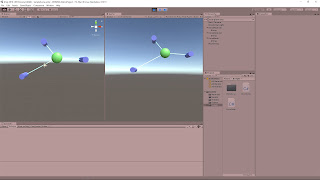
May 24th, 2018 Engineering Statics Game Concept - 00 Vimeo - Concept for Engineering Statics Game This was a quick proof of concept to show the idea from the last post at work. This concept takes inspiration from the hands on engineering kit that used masses on strings tugging on a central ring object to teach topics such as center of mass and vector math. The forces from the nodes on the ring are calculated to emulate that of a mass attached to a string. Each node has a mass value associated with it (which would be the mass hanging off of it in the real world kit), and this influences how much force that node is applying to the main circular object. Moving the nodes or changing their mass value will influence the position of the ring, as it effectively represents the center of mass of the entire system through the forces applied by the nodes. Using a simple example, I was quickly able to run a test to double check if the values provided by this toy were matching that of th...

DIGM 540 - Engineering Statics Game Project - Forces in Unity

Image
May 23rd, 2018 Forces in Unity AddForce - Unity Official Tutorials Youtube - AddForce - Unity Official Tutorials The bare basics of scripting forces in Unity with rigidBody's. The AddForce can take two inputs: a vector for direction and magnitude, and what type of force it is. ForceModes Acceleration - Continuous change; not affected by mass Force - (Default) Continuous change; affected by mass Impulse - Instant change; affected by mass VelocityChange - Instant change; not affected by mass AddTorque - Unity Official Tutorials Youtube - AddTorque - Unity Official Tutorials The bare basics of scripting torques in Unity with rigidBody's. The AddTorque can take two inputs: a vector axis to apply torque around, and what type of torque it is. This is very similar to AddForce. Important to remember, Unity uses "LEFT HAND RULE" for rotation. ForceModes Acceleration - Continuous change; not affected by mass Force - (Default) Continuous change; affected by ma...

Talks Every Game Designer Should Watch

May 23rd, 2018 Talks Every Game Designer Should Watch These are two talks suggested to be seen by anyone in game design by Squirrel Eiserloh in his talk "GDC 2015 - Math for Game Programmers: Fast and Funky 1D Nonlinear Transformations". They cover general game design topics on making your game feel good no matter the concept. Juice it or lose it - a talk by Martin Jonasson & Petri Purho Youtube - Juice It or Lose It Jan Willem Nijman - Vlambeer - "The art of screenshake" Youtube - The Art of Screenshake
May 22nd, 2018 Research Papers on Procedural Content Generation for Games Darwin’s Avatars: A Novel Combination of Gameplay and Procedural Content Generation by: Dan Lessin, Sebastian Risi Citation : [Lessin & Risi, 2015] D. Lessin and S. Risi, “Darwin’s Avatars: A Novel Combination of Gameplay and Procedural Content Generation,” 2015, pp. 329–336. Key Terms: Evolved Virtual Creatures Artificial Life Muscles Drives Physics-based Character Animation Procedural Content Generation Summary Use evolved virtual creature (EVC) system from Lessin et al. reference to procedurally generate creatures that provided interesting control and locomotion problems. Originally these were piloted by an AI trying to learn how to move, but this “brain” was removed for this paper so that players could run them. Movement was determined by the activation of muscles/actuators between the procedurally generated segments of the creatures. These muscles could range in value from [0, 1], whe...